
The Interesting Reality of Trolling Motors: Types and Features Explained
One of the most useful pieces of gear on any fishing boat is a motor most people barely notice until they actually need it, and that is exactly the role a trolling motor plays. Unlike the main outboard that gets you to a spot, this smaller motor is built for quiet, precise movement once you are already there, letting you hold position, creep along a shoreline or fight a current without spooking the fish or burning through fuel.
Features of Trolling Motors
Thrust Rating
Thrust, measured in pounds, is how much pushing power a motor has, and it is typically the first spec anglers look at when comparing most boat trolling motors. A larger, heavier boat needs a higher thrust rating to move efficiently, while a lighter kayak or canoe can get by with a much smaller motor. As a rough rule, you want about pounds of thrust for every 100 pounds of fully loaded boat weight, though wind and current can push that number higher.
Steering Mechanism
Steering on a trolling motor comes in a few forms, ranging from a simple hand tiller to foot pedals and wireless remotes. Hand tiller models are the most affordable and straightforward, which makes them popular with smaller boats, while foot-controlled and remote systems free up your hands for casting, something serious anglers tend to prioritise.
Noise Level
Fish are more sensitive to vibration and sound than most people realise, so a quiet motor can make a real difference in how many bites you get. An electric trolling motor is already far quieter than a gas outboard, but build quality still varies, since better-insulated motors run smoother and with less prop cavitation. This is especially important in clear, shallow water where fish spook easily.
Variable Speed Controller
A variable speed controller lets you fine-tune your motor’s output rather than being stuck with a handful of fixed settings. This is helpful when you need to creep along at barely a crawl to hold a trolling pattern, then bump up the power to reposition quickly. Digital variable speed systems, as opposed to older pulse-width models, also tend to draw less battery power at low speeds, which helps extend your time on the water.
Sonar Integration
Many modern trolling motors for sale come with a built-in sonar transducer mounted on the lower unit, feeding depth and fish location data straight to your display. This setup gives you a clearer picture of what is beneath the boat without adding a separate transducer to your hull, and it tends to track structure more accurately since it moves with the motor.
Spot-Lock
Spot-lock and similar anchor-lock systems from other brands use GPS to hold your boat in a single position without dropping a physical anchor. This is especially useful over structure like brush piles or rock ledges, where a real anchor could get stuck or damage the area. Since the system makes small automatic corrections for wind and current, it also helps keep your casting angle consistent the whole time you are fishing a spot.
Battery System
Battery setup is where a lot of anglers underestimate what they actually need, since trolling motors draw a fair amount of power, especially at higher thrust settings. Most 12-volt systems run on a single deep-cycle battery, while higher-thrust 24-volt and 36-volt motors require two or three batteries wired together. Lithium batteries, though pricier upfront, are lighter and last longer than lead-acid options, which is why more anglers are switching.
Freshwater vs Saltwater
Freshwater and saltwater models are not interchangeable, no matter how similar they might look on a shelf. When it comes to saltwater fishing, trolling motors for sale, just like the lures, are made of longer-lasting materials, since saltwater is far more corrosive and can quickly break down parts not built to handle it. This is why saltwater-rated motors typically feature sealed electronics and coated shafts, while standard freshwater models can rust or fail quickly if used in the ocean.
Types of Trolling Motors
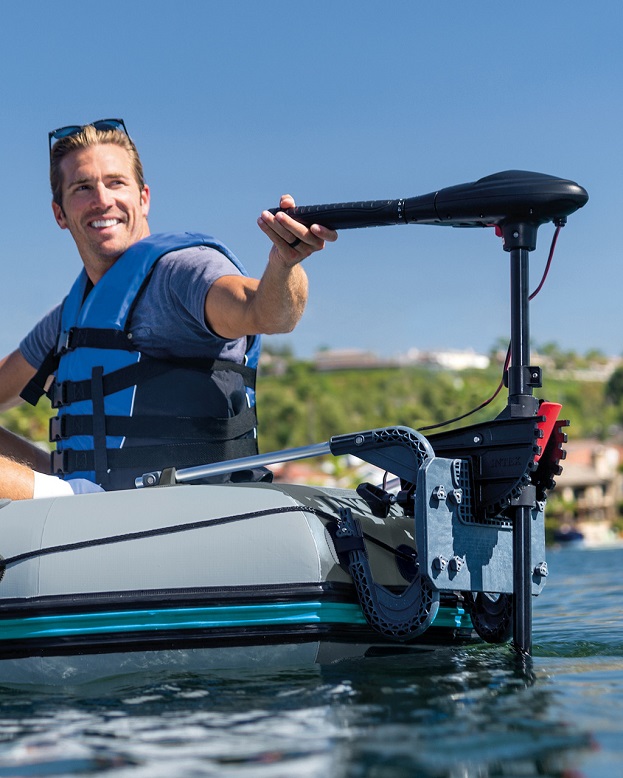
Transom-Mount
Transom-mount motors attach to the back of the boat, making them the most common choice for smaller aluminium boats, canoes and kayaks. They are typically the most affordable option and easiest to install, since they usually clamp onto the transom without any drilling. While they work well for basic positioning, they do not offer the same fine control as bow-mounted systems, which is why serious anglers often outgrow them.
Bow-Mount
Bow-mount motors sit at the front of the boat, pulling rather than pushing it through the water, which gives you noticeably better control and precision. This positioning is especially useful for holding a steady line along cover or drifting a shoreline, since the motor responds faster to steering input up front. As you would expect, these motors cost more than transom models, but the improved handling makes them the top pick for dedicated bass and walleye anglers.
Engine-Mount
An engine-mount or transom bracket trolling motor attaches directly to the lower unit of your main outboard rather than to the boat itself. This setup is common on larger saltwater boats, since it keeps the trolling motor out of the way while still providing solid thrust for slow trolling or fine positioning. It is a less common setup than bow or transom mounts, but it is a practical option for boats where there’s limited deck space.


