
The Ultimate Golf Irons Buying Guide: Understanding Sets and Shaft Flex
As a golfer reading this, you probably know that irons are some of the most important clubs in your bag. They’re versatile for a wide range of situations, from approach shots to playing from tricky lies. A typical golf bag includes several irons, each covering a different distance and type of shot. Therefore, it makes perfect sense to have them as part of a coordinated set.
Why Are Golf Irons Sold in Sets?
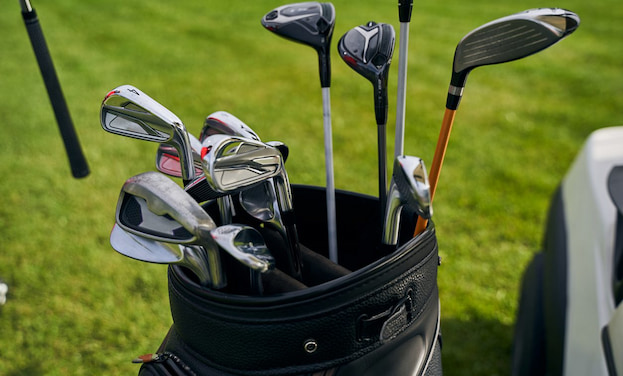
Golf irons are usually sold in sets because each club complements the next. While the loft, length and head design change from one iron to another, they are made to create consistent gaps between your distances. This gives you a selection of clubs for different situations rather than relying on one iron for every shot.
Buying golf iron sets is also more practical than choosing every iron individually. The clubs are designed to work together, so you get a consistent feel, appearance and performance from one end of the set to the other. You also don’t have to spend time trying to match different models, shafts or specifications.
A typical iron set might include a 4-iron through to a pitching wedge (although this varies between manufacturers and models). Many modern sets start at a 5-iron or a 6-iron, with longer clubs replaced by hybrids or fairway woods. Some sets may also include a gap wedge or approach wedge to provide another option for shorter shots.
The progression between the irons is important. A lower-numbered iron, such as a 4-iron, generally has less loft and a longer shaft, making it suitable for longer shots. As the number increases, the loft generally increases, and the shaft becomes shorter, allowing you to hit shorter and more controlled shots. This progression gives you a useful range of distances throughout the set.
That doesn’t mean you have to buy every iron available. If you already carry hybrids, for example, you may not need a 4-iron. The goal is to choose a set that fills the distance gaps in your bag and gives you clubs you feel confident using.
What to Look for When Buying Golf Iron Sets
Once you know why irons are sold as sets, the next step is finding one that suits your game. There are several things worth considering, including set composition, shaft and your skill level and playing style.
Set Composition
Start by looking at exactly what is included in the set. Don’t assume that every iron set contains the same clubs. One manufacturer’s set might run from a 4-iron to a pitching wedge, while another may offer a 5-iron to a pitching wedge.
Think about the clubs already in your bag and the distances you need to cover. If you already have a hybrid that performs well at the distance you would normally use a 4-iron, choosing a set that starts with a 5-iron may make more sense. Similarly, consider what you use around the green and whether you need an additional wedge.
It’s also worth looking at the lofts rather than relying only on the club number. Iron lofts can vary between models, so a 7-iron from one set may have a different loft from a 7-iron in another. Checking the specifications helps you understand how the clubs will fit into your existing distance gaps.
The aim is to create a smooth progression through your bag. You want enough separation between clubs that each one has a clear purpose, without leaving large gaps where you don’t have a reliable option.
Shaft
The shaft is another important consideration because it influences how the club feels and how it performs during your swing. Golf iron shafts are commonly available in steel or graphite, with different weights and flexes to suit different golfers.
Steel shafts tend to be heavier and are popular with players who want a solid, stable feel. Graphite shafts are generally lighter and can make it easier for some golfers to generate clubhead speed. Neither option is automatically better; what matters is finding a shaft that works with your swing.
Shaft flex is also worth considering. Regular, stiff and other flex options are designed to suit different swing characteristics. Choosing the right flex can help you achieve a more consistent feel and ball flight.
If you’re unsure which shaft is appropriate, a professional fitting can be useful.
Skill Level and Playing Style
Your experience and playing style should also influence the type of golf iron set you choose. Golfers who are still developing their game often benefit from irons designed to make shots easier to launch and more forgiving when contact isn’t perfect.
Game-improvement irons, for instance, usually have larger heads and features designed to provide more forgiveness. They can be a useful choice for beginners and higher-handicap golfers who want more help on off-centre strikes.
More experienced golfers may prefer irons that offer greater control and a more compact head shape. Players who consistently strike the ball well may prioritise feel, workability and the ability to shape shots rather than maximum forgiveness.
Your playing style matters too. If you tend to struggle getting the ball airborne, look for irons designed to help with launch. If distance is a priority, you may prefer a model designed to generate faster ball speeds. If you value control and precision, a different head design may be more suitable.


